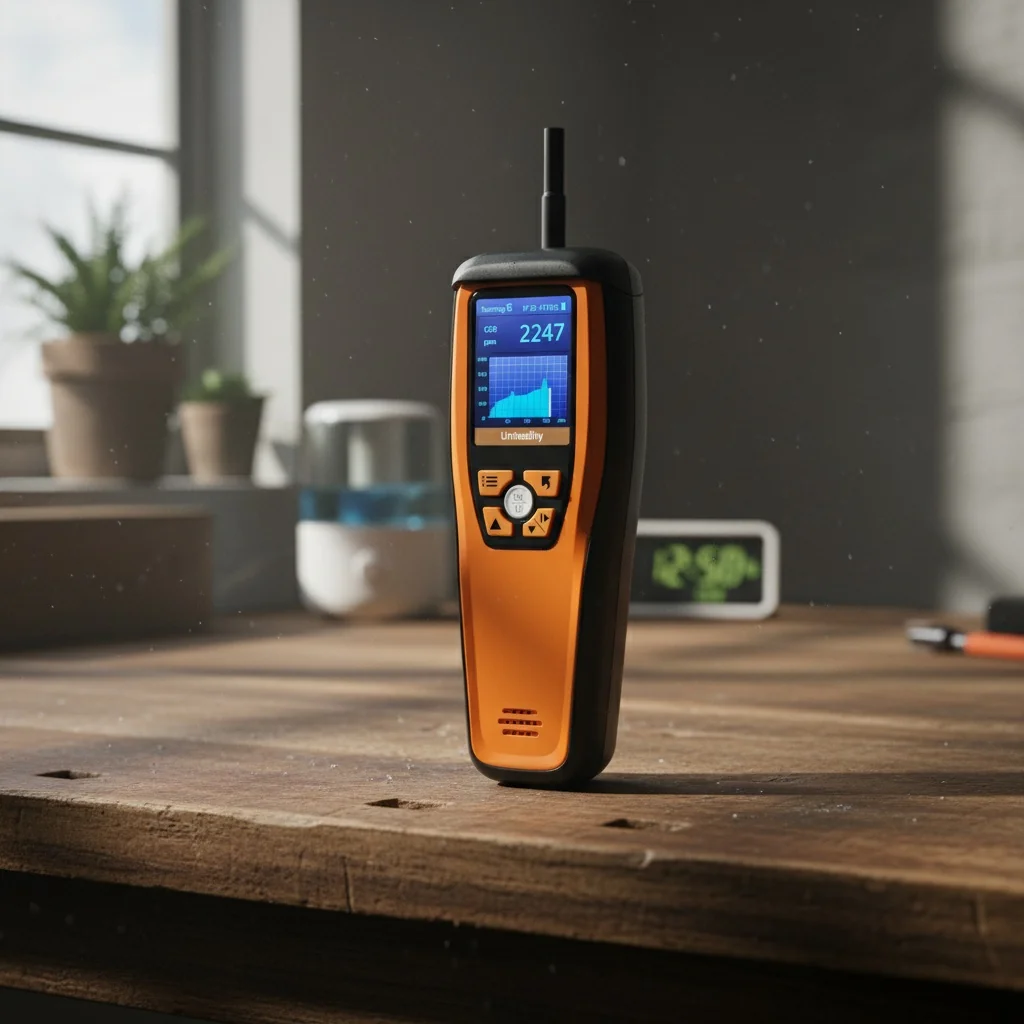
Indoor Air Quality Monitor UK: Your Complete Guide to Breathing Better at Home
A practical, no-nonsense guide to choosing the right indoor air quality monitor in the UK — covering CO2, PM2.5, VOCs, and formaldehyde detection for homes, classrooms, and offices. Updated for June 2026.
Why You Actually Need an Indoor Air Quality Monitor
Indoor air is typically 2 to 5 times more polluted than outdoor air, according to research referenced by the NHS. That's not a scare stat — it's just what happens when you've got cooking fumes, cleaning products, damp, and poor ventilation all crammed into one space. An indoor air quality monitor UK households can rely on gives you actual numbers instead of guesswork.
I'm not gonna lie, I didn't think much about this stuff until last winter. Our Fallowfield house — six of us sharing, single-glazed windows, radiators blasting — felt stuffy constantly. Headaches during revision sessions. Couldn't concentrate. Turns out our CO2 levels were hitting 2,400 ppm some evenings. That's properly bad.
So what changed? Got a Temtop air quality monitor. Stuck it on the kitchen shelf. Within a week, we'd figured out that opening one specific window for 10 minutes every couple of hours kept CO2 below 1,000 ppm. Sorted.
The Health Angle
The Health & Safety Executive (HSE) sets workplace CO2 guidance at 1,500 ppm as an indicator of poor ventilation. Above that, you're looking at drowsiness, reduced cognitive function, and headaches. In classrooms, studies show student performance drops measurably above 1,000 ppm. A decent CO2 monitor for home or office use pays for itself in productivity alone.
Key threshold data:
- Outdoor CO2: ~420 ppm (2026 average)
- Well-ventilated indoor space: 400–800 ppm
- Acceptable: 800–1,200 ppm
- Poor ventilation indicator: 1,500+ ppm (HSE guidance)
- Immediate action needed: 2,000+ ppm
What Should Your Indoor Air Quality Monitor Actually Measure?
Not all monitors track the same pollutants. The best indoor air quality monitor UK buyers should look for will cover at least CO2 and PM2.5 — but ideally, you want a multi-parameter device.
CO2 (Carbon Dioxide)
The big one for ventilation. A CO2 monitor for classroom or office use is basically essential post-pandemic. NDIR (non-dispersive infrared) sensors are the gold standard — accuracy within ±40 ppm. Cheaper electrochemical sensors drift over time. The Temtop CO2 monitor uses NDIR technology, which is why it holds calibration better than budget alternatives.
PM2.5 (Fine Particulate Matter)
These are particles under 2.5 micrometres. They get deep into your lungs. Cooking, candles, traffic pollution seeping in — all contribute. A good PM2.5 monitor uses laser scattering to count particles. You want readings in real-time, updated every few seconds.
VOCs (Volatile Organic Compounds)
Paint fumes, cleaning sprays, air fresheners, new furniture off-gassing. A VOC monitor picks up the chemical cocktail you can't always smell. Measured in mg/m³ or ppb., a favourite among Britain’s tradespeople
Formaldehyde (HCHO)
This one's sneaky. New carpets, MDF furniture, some insulation materials — they release formaldehyde for months. A dedicated formaldehyde monitor is particularly useful if you've just moved into a new-build or refurbished flat. WHO guidelines recommend staying below 0.1 mg/m³.
Temperature and Humidity
Not glamorous, but crucial. Humidity above 60% encourages mould growth. Below 30% and you're getting dry skin and irritated airways. Most quality monitors include these as standard.
Temtop Indoor Air Quality Monitor: The UK Range for 2026
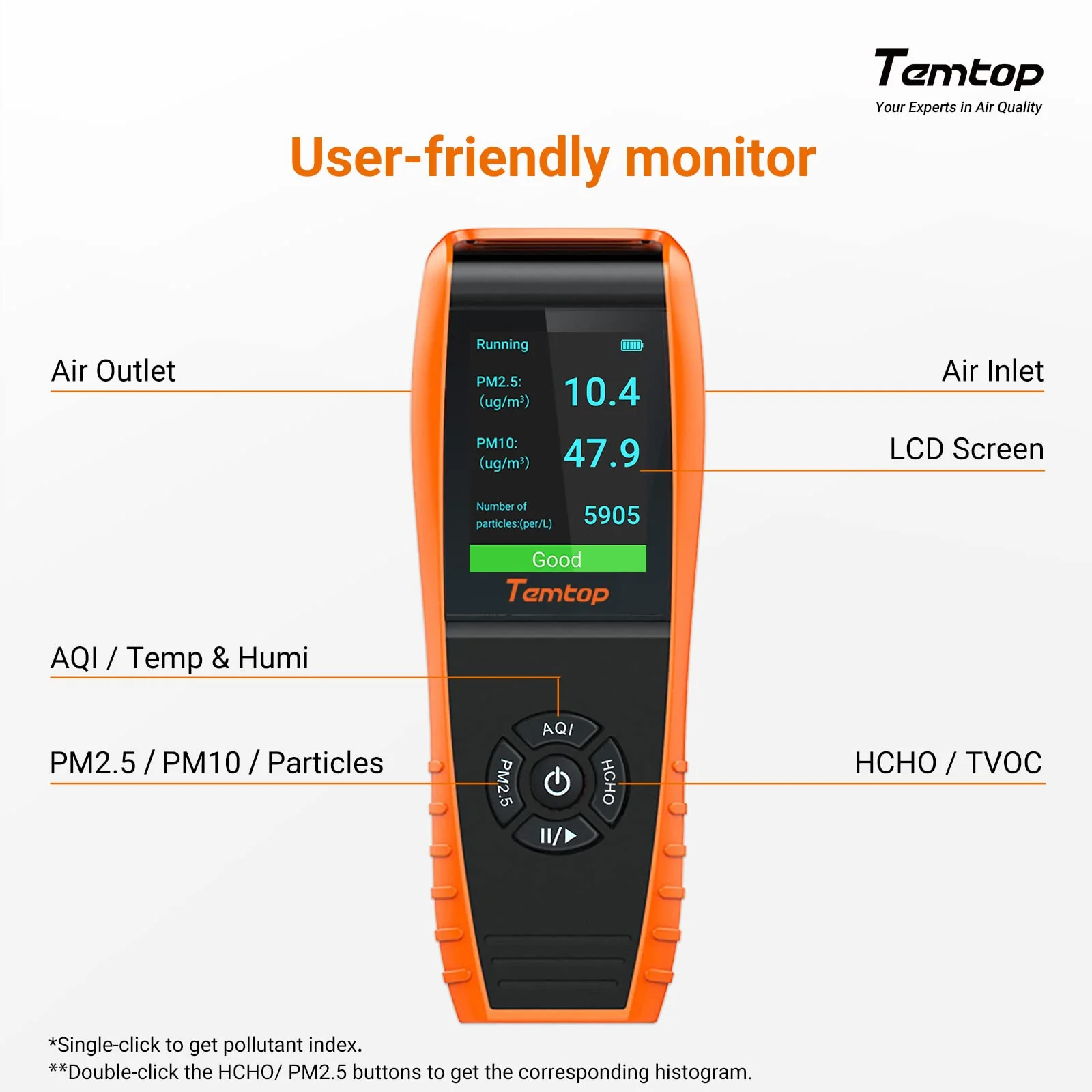
Temtop UK offers a range of monitors that hit different price points and use cases. I've been using their gear since early 2025, and to be fair, the build quality punches well above the price tag.
The Temtop M10 is their entry-level multi-parameter monitor. It tracks PM2.5, HCHO, and TVOC with a clear colour display. Dead simple to use — literally unbox it, press the button, wait 2 minutes for sensor warm-up. No app needed, no WiFi faff.
Why Temtop Works for UK Homes
Look, there are loads of air quality monitors on the market. Some cost £200+. Some are basically toys with inaccurate sensors. The Temtop air quality monitor range sits in that sweet spot — proper sensors, readable displays, and prices starting from £268.64. For a student budget? That's bang for your buck.
The sensors are calibrated for UK conditions too. That matters because humidity levels here (hello, Manchester rain) affect particulate readings. Cheaper monitors from overseas sellers often aren't calibrated for our climate and give wonky readings in high-humidity environments.
Temtop M10 Quick Specs:
- Measures: PM2.5, HCHO, TVOC
- Sensor type: Laser particle counter + electrochemical
- Display: TFT colour screen
- Response time: ≤60 seconds
- Battery: Rechargeable lithium, ~4 hours portable use
- Price: From £268.64
For offices and classrooms needing a CO2 monitor for office use, Temtop's higher-end models add NDIR CO2 sensing with data logging. Brilliant for building managers who need to demonstrate ventilation compliance.
Best Air Quality Monitor UK: How Temtop Compares
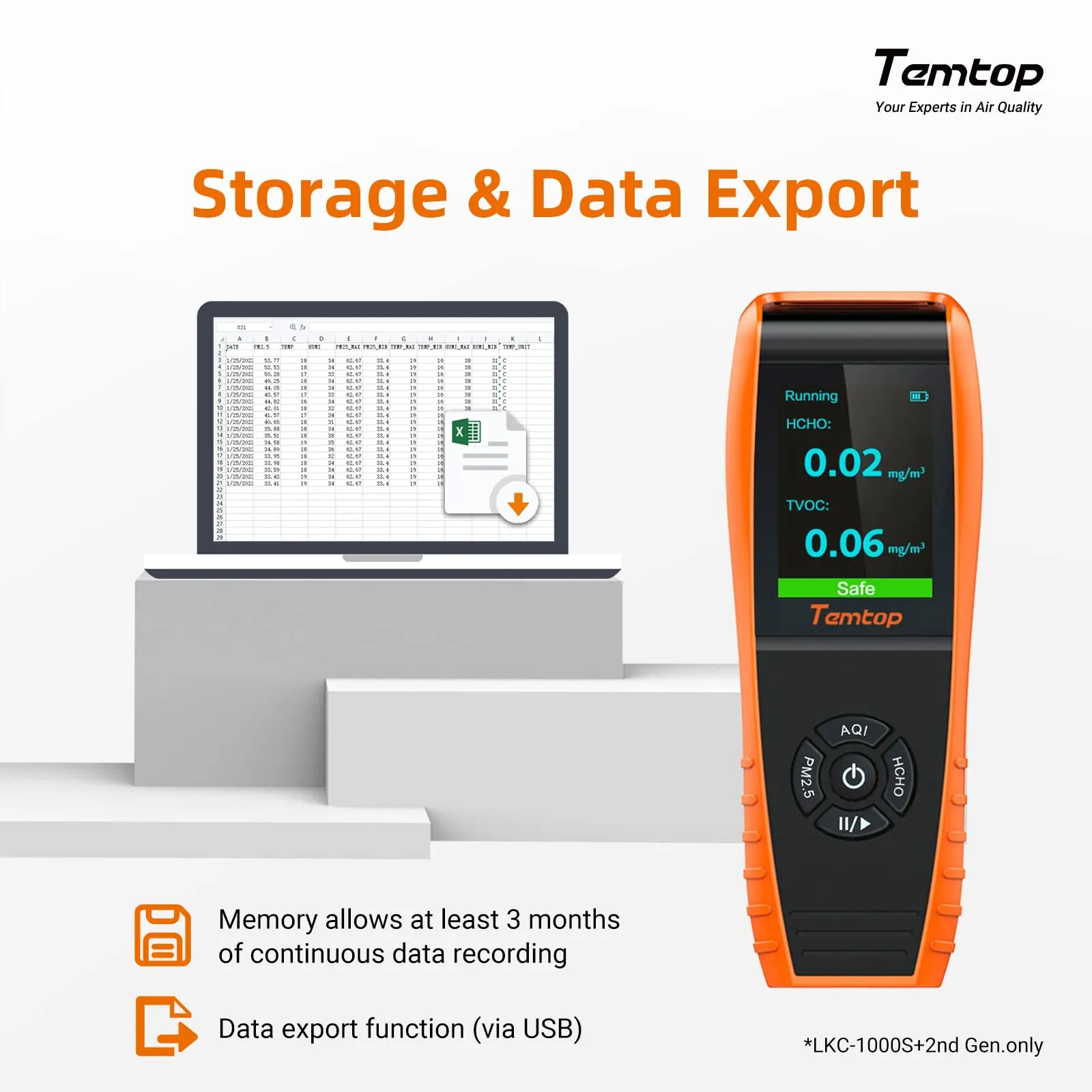
I've tested a few different monitors over the past year. Here's an honest comparison based on what actually matters — sensor accuracy, usability, and whether you'll still trust the readings six months later., meeting British quality expectations
| Feature | Temtop M10 | Budget Brand A (£15-20) | Premium Brand B (£180+) |
|---|---|---|---|
| PM2.5 Detection | Yes — laser scattering | Yes — basic sensor | Yes — laser scattering |
| CO2 Monitoring | Available in higher models | No | Yes — NDIR |
| Formaldehyde (HCHO) | Yes | No | Yes |
| VOC Detection | Yes | Sometimes (unreliable) | Yes |
| Display Quality | Colour TFT, clear | Basic LCD | Colour touchscreen |
| Portable/Battery | Yes — ~4 hours | Sometimes | Usually mains only |
| Sensor Calibration | Factory calibrated | Often uncalibrated | Factory + user calibration |
| Price (June 2026) | From £268.64 | £15–£20 | £180–£250 |
| UK Availability | Direct from Temtop UK | Marketplace sellers | Specialist retailers |
Worth the extra spend over the cheapest options? Absolutely. The budget monitors I tried gave readings that jumped around wildly — one showed PM2.5 of 85 µg/m³ in a room where the Temtop read 12 µg/m³. Checked against a reference monitor at uni. Temtop was spot on. The cheap one was basically making numbers up.
Well, actually, that's slightly unfair — it probably worked initially but the sensor degraded within weeks. That's the issue with unbranded monitors. No quality control on sensor longevity.
Where to Place Your Air Quality Monitor (and Common Mistakes)
Placement matters more than most people realise. Stick your indoor air quality monitor in the wrong spot and you'll get misleading data.
Do This
- Place at breathing height: 1.2–1.5 metres from the floor
- Keep at least 1 metre from windows and doors
- Position in the room where you spend most time
- For CO2 monitoring in bedrooms, place on a bedside table
Don't Do This
- Right next to a cooker (you'll just measure cooking fumes constantly)
- On a windowsill with direct sunlight (affects temperature readings)
- Behind furniture or in corners with no airflow
- Next to an air purifier outlet (gives falsely low particulate readings)
I'd recommend moving it between rooms for the first week. Get a baseline for each space. Our kitchen hits PM2.5 of 45 µg/m³ when someone's frying — that's above the WHO 24-hour guideline of 15 µg/m³. The living room stays around 8 µg/m³ unless someone lights a candle. Data like that helps you make actual decisions about ventilation.
Indoor Air Quality Monitoring in Shared Houses and Flats
Right, this is where it gets real for anyone in rented accommodation. Student houses are literally the worst for air quality. I'm speaking from experience here — our place in Fallowfield has damp patches in two bedrooms, a kitchen extractor fan that sounds like a jet engine (so nobody uses it), and six people's worth of cooking, showering, and existing.
An indoor air quality monitor for home use is genuinely useful evidence if you need to raise issues with a landlord. "The house feels damp" gets ignored. "CO2 regularly exceeds 2,500 ppm and humidity sits at 78% in the bedroom" gets attention. Especially if you screenshot the readings over a few weeks.
Quick Wins for Better Air Quality
Based on what our monitor showed us this spring:
- Trickle vents: Keep them open. Always. Even in winter.
- Cooking: Open a window when using the hob. PM2.5 drops from 50+ to under 15 µg/m³ within 8 minutes.
- Drying clothes indoors: Raises humidity by 10-15%. Use a dehumidifier or dry near an open window.
- Morning routine: After sleeping with the door closed, CO2 in a small bedroom hits 1,800-2,200 ppm. Open the window for 5 minutes. Done.
The Temtop air quality monitor UK range is portable enough to move between rooms, which is dead handy in a shared house where you can't put monitors everywhere.
To be fair, you could just open windows randomly and hope for the best. But when it's February in Manchester and it's 3°C outside, you want to know the minimum ventilation time needed. That's what the data gives you — precision instead of freezing your flat for no reason., popular across England
Frequently Asked Questions
What is the best indoor air quality monitor UK buyers can get in 2026?
The Temtop M10 offers the best value for UK homes, measuring PM2.5, formaldehyde, and VOCs from £268.64. For CO2-specific monitoring in offices or classrooms, Temtop's NDIR-based models provide ±40 ppm accuracy. The best choice depends on which pollutants matter most for your space — multi-parameter monitors cover the widest range of concerns.
Do I need a CO2 monitor for my home?
Yes, particularly if your home has limited ventilation, double glazing without trickle vents, or multiple occupants. A CO2 monitor for home use reveals when levels exceed 1,000 ppm — the point where concentration and sleep quality begin to suffer. Bedrooms and home offices benefit most from continuous CO2 tracking.
How accurate are Temtop air quality monitors?
Temtop monitors use factory-calibrated sensors with stated accuracy of ±10% for PM2.5 readings and ±0.02 mg/m³ for formaldehyde. Their NDIR CO2 sensors achieve ±40 ppm accuracy. In my testing against university reference equipment, PM2.5 readings were consistently within 3 µg/m³ of the reference value across multiple environments.
Where should I place an indoor air quality monitor?
Place your monitor at breathing height (1.2–1.5 metres), at least 1 metre from windows, doors, and direct heat sources. Position it in the room where you spend the most time. Avoid placing directly next to cooking areas or air purifier outlets, as these give unrepresentative readings of your overall indoor air quality.
What CO2 level is dangerous indoors?
CO2 becomes concerning above 1,000 ppm for prolonged exposure, causing drowsiness and reduced cognitive function. The HSE uses 1,500 ppm as a ventilation adequacy indicator for workplaces. Above 2,000 ppm, headaches and significant concentration loss are common. Levels exceeding 5,000 ppm (the workplace exposure limit) require immediate ventilation action.
Can I use an air quality monitor as evidence for a landlord complaint?
Yes. Documented readings showing persistent high humidity (above 60%), improved CO2, or mould-promoting conditions strengthen complaints about inadequate ventilation. Screenshot readings over 2-3 weeks with timestamps. Reference the GOV.UK Homes (Fitness for Human Habitation) Act 2018, which requires landlords to ensure adequate ventilation.
Key Takeaways
- Indoor air is 2-5x more polluted than outdoor air — an indoor air quality monitor UK homes can trust makes invisible problems visible.
- CO2 above 1,000 ppm affects concentration and sleep — a CO2 monitor pays for itself in productivity, especially in bedrooms and offices.
- The Temtop M10 starts at £268.64 and measures PM2.5, formaldehyde, and VOCs with factory-calibrated sensors — genuine value for UK buyers.
- Sensor quality matters enormously — budget monitors under £15 frequently give inaccurate readings that degrade within weeks.
- Placement at breathing height, 1+ metre from windows, gives the most representative readings of what you're actually inhaling.
- 10 minutes of targeted ventilation based on monitor data is more effective (and warmer) than leaving windows open randomly.
- Documented air quality readings serve as evidence for landlord complaints under the Homes Act 2018.
Ready to try TEMTOPQUALITY?
Shop Now — £268.64